
How to Compare These Places
The places to visit in Kathmandu differ in religious setting, urban form, and the details visitors can observe. Some are active religious complexes; others are historic squares embedded in older city centers. Comparing those features helps clarify whether a site suits an interest in worship spaces, traditional architecture, or streetscape photography. The five landmarks below are all in Kathmandu Valley, though they represent distinct settings.
Comparison Criteria
Compare each place by its cultural setting, built form, and strongest visual details. The table distinguishes religious complexes from historic squares without treating one type as better than another.
| Place | Setting and urban form | Useful observation or photography focus |
|---|---|---|
| Boudhanath Stupa | Buddhist religious landmark centered on a stupa | Stupa form, surrounding devotional spaces, and the wider religious setting |
| Pashupatinath Temple | Hindu temple complex with a religious and riverside setting | Temple architecture and the relationship between the complex and its surroundings |
| Swayambhunath Temple | Buddhist religious complex on a hilltop | Architectural details and elevated views across the city |
| Patan Durbar Square | Historic square within Lalitpur’s urban center | Traditional Newari architecture, façades, and the square’s built edges |
| Bhaktapur Durbar Square | Historic square within Bhaktapur’s old center | Historic buildings and the relationship between the square and nearby religious structures |
For closer comparisons, look at whether a place is organized around a religious focal point or a public square. Architecture, courtyards, and city views offer different subjects for observation and photography.
Selection Scope
Boudhanath, Pashupatinath, Swayambhunath, Patan, and Bhaktapur are all in Kathmandu Valley. Their inclusion reflects a range of site types: Buddhist and Hindu religious landmarks, hilltop and riverside settings, and historic urban squares. This selection is a guide to those differences, not a live access guide; conditions and opening arrangements can change. It is also not an empirical ranking based on visitor numbers, reviews, or measured quality. For a practical choice, start with the setting and subject you most want to experience, then confirm current access details before setting out.
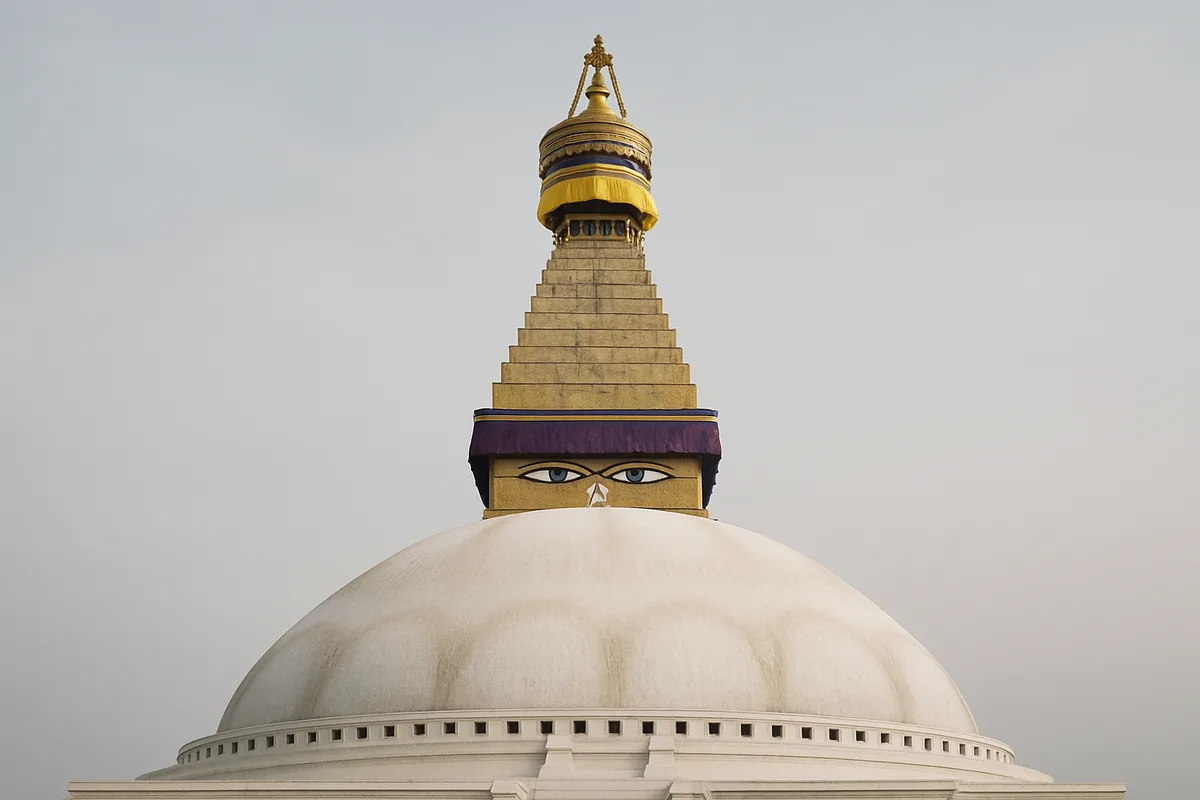
Boudhanath
Boudhanath is a Buddhist stupa in Kathmandu and a prominent destination for visitors interested in religious landmarks in Kathmandu. Its central monument shapes the experience: the surrounding buildings, devotional practices, and visitor movement all relate to the stupa. This makes a visit distinct from a historic-square visit, where several structures share attention across an open space. The site rewards close observation of its architecture as well as the activity around its perimeter. It is a strong choice for a focused encounter with Kathmandu’s Buddhist heritage.
Stupa and Religious Setting
Boudhanath is a Buddhist stupa in Kathmandu, with a large white dome forming the dominant feature of its religious setting. A stupa is a devotional monument associated with Buddhist practice, rather than a building arranged as an interior worship hall. At Boudhanath, the dome rises from a broad stepped base, making the monument visible above the surrounding roofs and giving the site a clear architectural center.
Above the dome, a square structure known as the harmika bears the Buddha’s painted eyes, while a tiered spire rises above it. These elements create a vertical sequence that draws the eye upward from the base to the pinnacle. Prayer flags extend from the tower toward nearby buildings, adding lines of color across the space without displacing the stupa as its focal point.
The surrounding religious activity is organized in relation to this central monument. Worshippers and visitors move around its base in circumambulation, following a repeated circuit rather than gathering only at a single doorway. Prayer wheels and devotional objects along the route support this practice, while nearby monasteries and other religious buildings give the perimeter an active Buddhist character. The result is a sacred setting where the monument, its circular path, and daily acts of devotion belong to one connected composition.
A Stupa-Focused Visit
A stupa-focused visit keeps attention on one monument and the space arranged around it. At Boudhanath, the circular route makes the base, white dome, harmika, and rising spire legible as parts of a single structure. Walking around the monument reveals changing views of its profile, while the prayer flags show how the central tower connects visually with surrounding rooftops.
The experience differs from observing a historic square, where several facades and buildings compete for attention across an open area. Here, the main spatial relationship is between the stupa and the encircling path: the monument remains the center, and movement follows its perimeter. The surrounding religious buildings form a secondary layer, framing the central structure rather than acting as separate square-front landmarks.
Look for how the stepped base supports the dome, how the harmika marks the transition to the spire, and how repeated circumambulation shapes the flow of people around the monument. These details make the visit architectural as well as devotional. For a concise Kathmandu heritage stop, allow time to observe one full circuit and the stupa from more than one angle; that approach best reveals its form and religious setting.
Pashupatinath
Pashupatinath offers a view of Kathmandu’s religious life through its temple precinct and riverfront setting. The site’s character comes from active worship alongside the Bagmati, rather than from architecture alone. Its meaning is rooted in Hindu devotion to Shiva and in practices associated with the river. Visitors can approach it as a living place of worship, observing its surroundings with care.
Hindu Temple Complex
Pashupatinath is a major Hindu temple complex by the Bagmati River, dedicated to Shiva in his form as Pashupati, often regarded as the lord of living beings. For Hindu worshippers, this is not simply a historic monument: it is an active religious destination where devotion, prayer, and offerings give the precinct its daily purpose. The main shrine’s tiered pagoda form and gilded roof make it a prominent architectural feature, while smaller shrines and sacred spaces contribute to the larger complex.
The Bagmati is part of the site’s religious meaning as well as its physical setting. In Hindu traditions, rivers can hold sacred associations, and the riverfront at Pashupatinath is connected with rites marking important stages of life and death. Steps, platforms, and shrines close to the water create a landscape where worship and riverside activity are visible together. This setting distinguishes Pashupatinath from Kathmandu temples located within dense streets or historic squares: the river is central to the way the complex is experienced.
The site’s religious significance rests on both elements: Shiva devotion within the temple precinct and the Bagmati’s role in the surrounding ritual landscape.
Riverside Observation
Pashupatinath is a living place of worship, so observation calls for attention to the people and activities around the Bagmati as well as to the buildings. Worshippers may be praying, making offerings, or taking part in rites at the riverfront. Keep a composed presence, leave room for people engaged in religious acts, and avoid treating ceremonies as staged scenes for visitors. Watching quietly from an unobtrusive position helps preserve the distinction between observing a place and interrupting its use.
Photography deserves particular care around worship, rituals, and individuals. A camera can turn a private or solemn moment into a public image, especially at riverfront rites connected with death. Consider whether a photograph is necessary, avoid close or intrusive framing, and seek permission before making a person the subject of a portrait. When permission is unclear or a ritual feels especially personal, lowering the camera is the more considerate choice. Do not assume that a visible activity is intended for documentation.
Plan to spend time noticing the relationship between the shrines, the river, and the people using the site, rather than focusing only on photographs. Quiet observation is the most practical way to appreciate Pashupatinath while respecting its religious purpose.
Swayambhunath
Swayambhunath is a Buddhist religious complex on a hill above Kathmandu, where sacred buildings and the surrounding urban landscape share a distinctive setting. Its elevated position shapes both the approach and the way the complex is experienced: visitors climb toward a place of worship while the city opens out below. The site is among the best-known places to visit in Kathmandu for its religious character and views. Its hilltop setting, rather than a single building alone, defines the visit.
Hilltop Religious Complex
Swayambhunath is a Buddhist religious complex set on a hill in Kathmandu, with the central stupa and surrounding shrines occupying the summit. The climb separates the site from the busy streets below and gives the approach a gradual, ceremonial quality. A long stairway ascends the eastern slope; as the city recedes, the religious buildings become the focus of the ascent. The hill is part of the experience, not simply a platform for the structures.
At the summit, worshippers and visitors move through a connected precinct of sacred monuments, smaller shrines, and spaces for prayer. Circumambulation around the stupa links movement through the complex with its Buddhist devotional purpose. The elevated location also keeps the site visually connected to Kathmandu: rooftops and neighborhoods extend across the valley beneath the hill. This combination of active religious space and prominent urban landmark gives Swayambhunath a character distinct from temples near Kathmandu city center, where streets and buildings press closer around the precinct.
Architecture and City Views
Within the complex, close observation reveals how individual religious structures form a layered ensemble. The white hemispherical dome of the stupa supports a square tower and a tapering, gilded spire; the Buddha eyes painted on the tower look out across the cardinal directions. Smaller shrines, sculpted details, prayer wheels, and votive objects add scale and texture around the main monument. Walking at an unhurried pace makes these details easiest to appreciate, as the stupa’s proportions and the varied forms of the surrounding buildings become apparent.
Looking outward offers a different perspective. From the hilltop, Kathmandu’s dense neighborhoods spread across the valley, with distant ridgelines framing the urban expanse on clear days. This broad view contrasts with the close, devotional focus of the precinct: one perspective takes in the city as a whole, while the other attends to crafted surfaces and sacred objects. Swayambhunath Temple therefore brings architecture and city outlook into one visit without making them the same experience. For a focused visit, allow time for both a circuit of the stupa and a pause at the hilltop viewpoints.
Patan Durbar Square
Patan Durbar Square is in Lalitpur, within Kathmandu Valley, and offers a historic-square setting rather than a visit focused on one shrine. The square brings together palace spaces, religious buildings, and the routes of a long-established city center. Its layout makes it a distinctive choice among places to visit in Kathmandu. The relationship between the square’s buildings and the surrounding streets shows how this part of Lalitpur functions as an urban place.
Historic Square in Lalitpur
Patan Durbar Square stands in Lalitpur, within Kathmandu Valley, south of the Bagmati River from central Kathmandu. Lalitpur developed as a historic city in its own right, and the square forms a civic center within its street network. Its significance comes from the way several kinds of urban space meet, not from a single religious monument.
The former royal palace complex faces the public square, while temples and smaller shrines occupy nearby spaces. Together, these buildings show how civic authority and religious practice were part of the same city center. The square is an open gathering place, but its edges lead into lanes, courtyards, and working parts of the old city rather than ending at a formal plaza.
That setting changes the rhythm of a visit. You can move from the square into adjoining streets and see shops and everyday activity alongside historic buildings. The public space is a point of connection between major landmarks and the surrounding neighborhood, not an isolated monument reached and viewed from one direction.
Patan presents a historic city center as a whole, making it especially useful for a Kathmandu cultural heritage tour. Visitors should allow time for the square and its immediate lanes, rather than treating the visit as a stop at one building.
Architectural and Urban Details
Read the square through its materials and changing building forms, then notice how the streets continue those details beyond the open space. Traditional Newari architecture is visible in the combination of brick, timber, and carefully worked stone.
- Palace façades: Compare the brick walls and layered rooflines around the former royal palace with the open space in front; the façades define the square’s civic edge.
- Carved windows: Look for timber window frames with pierced and carved patterns, especially on upper stories, where detailed woodwork contrasts with comparatively plain brick surfaces.
- Temple forms: Krishna Mandir, built in 1637 under King Siddhi Narasimha Malla, has a stone shikhara form that differs from the tiered-roof temples nearby.
- Courtyards: Palace courtyards such as Mul Chowk and Sundari Chowk draw visitors from the public square into enclosed spaces framed by arcades and carved timber details.
- Street edges: Follow the lanes adjoining the square to see how shops, entrances, and smaller courtyards connect landmark buildings to the dense historic urban fabric.
These details are easiest to read by alternating between a broad view across the square and close observation of doorways, windows, and courtyard entrances. A short practical approach is to begin with the square, then spend time in its adjoining lanes to see how its architecture belongs to Lalitpur’s wider city setting.
Bhaktapur Durbar Square
Bhaktapur Durbar Square offers a different perspective from Kathmandu’s more focused religious landmarks: its setting extends into the surrounding historic town. The square’s palace buildings, temples, lanes, and courtyards form a connected urban scene rather than a single destination viewed in isolation. This makes it a distinctive choice among places to visit in Kathmandu Valley. Its strongest appeal is the way architectural details sit within the rhythms and layout of an old town.
Historic-Center Setting
Bhaktapur Durbar Square is in Bhaktapur, within Kathmandu Valley, and forms part of a distinct historic urban setting. It is not simply a monument standing apart from its surroundings: the square connects with the lanes, courtyards, and other historic spaces of the town center.
Walking between Durbar Square, Taumadhi Square, and Dattatreya Square brings that connected layout into view. Narrow streets open onto broader public spaces, while traditional Newari architecture appears along the routes as well as around the principal square. The town’s historic character is therefore experienced across several linked settings, not only from the main square itself.
This urban scale distinguishes Bhaktapur from religious landmarks organized around a single focal complex. The palace frontage and temple structures occupy the square, while nearby streets continue the historic environment beyond its edges. Buildings, public spaces, and smaller courtyards read as parts of the same townscape, giving the visit a strong sense of place. Travelers interested in old streets and courtyards can best experience Bhaktapur as a historic center on foot, rather than as one isolated architectural stop.
Square and Religious Complexes
Bhaktapur’s square combines civic and religious architecture within an active historic center. These details help distinguish it both from single-focus religious complexes and from Patan Durbar Square.
- Bhaktapur’s 55-Window Palace gives the square a long palace frontage; at Boudhanath, the central stupa instead defines the visitor’s primary focus.
- The Golden Gate frames an entrance to the former palace complex, so palace architecture and access routes shape the square’s visual sequence.
- Vatsala Temple stands directly within the square, bringing a temple landmark into the same view as the palace buildings and open public space.
- Courtyards and passageways around the palace offer a more enclosed architectural rhythm than the broad, open worship setting around Boudhanath Stupa.
- Compared with the riverside religious complex at Pashupatinath, Bhaktapur places its principal buildings within a town square bordered by historic streets.
- Patan Durbar Square also combines temples with palace architecture, including Krishna Mandir; its layout feels more concentrated around the square than Bhaktapur’s linked town center.
- At Bhaktapur, streets lead onward toward other historic squares, while the main monuments remain visible as part of a wider urban setting.
Choose Bhaktapur when you want to compare temples, palace facades, courtyards, and surrounding streets in one connected historic center; choose a religious complex for a more focused landmark setting.
Choosing by Interest
The best places to visit in Kathmandu depend on whether you want a religious setting, a city panorama, or historic urban spaces. These interests can point to different sites, even when several share architectural or cultural appeal. Use each place’s defining character to narrow your choices rather than treating every stop as interchangeable. Then check current access and operating conditions separately before finalizing an itinerary.
Match the Site to Your Interests
Start with the setting you most want to experience; the same destination may suit one interest more strongly than another.
- If Buddhist sites are your priority, Boudhanath Stupa may suit a visit focused on a large stupa and its surrounding religious setting rather than historic squares.
- If a Hindu religious setting matters most, Pashupatinath Temple may be the better match, with its temple complex giving the visit a distinctly devotional character.
- If a hilltop outlook is high on your list, Swayambhunath’s elevated position combines a religious complex with broad views across the city.
- If you are drawn to historic squares, Kathmandu Durbar Square offers an old-town setting; Patan and Bhaktapur may appeal if you want to compare different historic centers.
These are interest-based matches, not rankings: a square may be more rewarding than a religious landmark for visitors focused on urban history and architecture. For a short itinerary, choose the setting that best fits your main interest, then add another site only if it offers a genuinely different experience.
Check Present-Day Conditions
A site’s enduring character does not confirm that access, opening arrangements, or visitor services are unchanged on the day you plan to go. Check current information for each destination independently, including any access restrictions, temporary closures, event-related changes, and transport conditions. These details can affect how much of a complex or square you can visit, even when its historic or religious significance remains the same. Verify them before setting out, then build your route around the places that are accessible and practical for your visit.