
How This Selection Is Organized
The things to do in Kathmandu covered here are compared through cultural setting, type of visit, and photography considerations. Together, these perspectives distinguish religious landmarks from historic public space and everyday neighborhood life. Kathmandu Travel and Photography Guide is an independent English-language information guide, not a business, service provider, school, organization, former domain project, or source of products or services. The places are presented for context, not as a tested or ranked itinerary.
Cultural Setting
The five places considered sit in Kathmandu Valley: Boudhanath Stupa and Swayambhunath Stupa are Buddhist landmarks, while Pashupatinath Temple is a Hindu religious site. Patan Durbar Square represents historic urban space, and Thamel is a contemporary neighborhood. This range gives Kathmandu sightseeing a broader frame than a list made up only of monuments.
The religious sites belong to distinct living traditions, while the square and neighborhood are encountered through public space and daily activity. These settings can make a visit feel very different even when places are part of the same valley. Kathmandu historic sites, in particular, make the most sense alongside the people and routines that continue to shape their surroundings.
This cultural comparison helps distinguish spiritual landmarks from architecture viewed in an urban setting and street life in a working neighborhood. It also avoids treating the five places as interchangeable stops: each offers a different relationship between heritage, community, and the visitor’s experience.
Type of Visit
A visit centered on an active religious place involves observing a setting where worship and other forms of devotion take place. Boudhanath, Swayambhunath, and Pashupatinath fall into this broad category, though their traditions and individual environments differ. The emphasis is on encountering a spiritual landmark as a living place rather than viewing it only as architecture.
Patan Durbar Square offers a different kind of visit: time in a historic public square, where buildings and open urban space form part of the experience. Thamel, by contrast, is a working neighborhood shaped by contemporary street life. These distinctions are useful when choosing among the best places to visit in Kathmandu, since a quiet architectural focus and an active street setting do not create the same pace or atmosphere.
The places are not a tested or ranked itinerary, and their order does not suggest that one is more worthwhile than another. They provide contrasting examples for a Kathmandu travel guide: religious settings, a historic square, and a neighborhood can each suit different interests without being combined into a prescribed route.
Photography Considerations
Photography offers another way to compare these places, from sacred activity and architectural detail to street scenes and wider views. A frame focused on a temple façade or carved surface differs from one that includes people moving through a public square. Neighborhood streets, meanwhile, can show the changing texture of everyday urban life rather than a single landmark.
At religious sites, worship and other sacred activity affect what is appropriate to photograph; respectful conduct matters more than securing a particular image. The same principle applies to people in public settings: a street scene is not simply a collection of visual details, and the presence of a camera can change an encounter. Local customs and the circumstances at the time shape what feels suitable.
Light, crowd levels, weather, and the available line of sight also influence whether close architectural details or broader views are practical. These conditions vary by place and moment, so photography is a useful comparison lens rather than a promise of a fixed composition. Across Kathmandu cultural attractions, the most fitting approach balances visual interest with attention to the setting and the people using it.
Boudhanath Stupa
Boudhanath Stupa is a Buddhist stupa in Kathmandu and a major Buddhist religious site. Its monumental white dome, layered spire, and surrounding devotional activity give it a distinct visual and cultural character. The open area around the monument is part of a living place of worship, not simply a backdrop for sightseeing. Visitors can appreciate its architecture and daily religious life by observing carefully and allowing worshippers space.
Religious and Visual Character
Boudhanath is a major Buddhist religious site in Kathmandu, with a large stupa at its center. A stupa is a Buddhist monument associated with sacred relics and devotional practice; its form is not designed as an ordinary building with rooms for visitors. The broad white dome rises above a stepped base, creating a strong, rounded silhouette visible across the surrounding square.
Above the dome, a square structure known as the harmika supports a tapering spire of diminishing levels. The painted eyes on its sides are among the most recognizable features of the monument, while prayer flags add shifting color above the roofline. Together, the geometric tiers, whitewashed surfaces, and bright details make the stupa legible from both close range and across the open space.
Its religious character is evident in the activity around it. Devotees circle the monument as an act of worship, turn prayer wheels, make offerings, or pause in prayer. Monks, residents, and pilgrims use the setting as part of an ongoing devotional landscape, so movement and quiet observance share the same space.
The surrounding buildings, balconies, shrines, and shops frame views of the central structure and connect the monument to everyday life in the neighborhood. This combination of sacred architecture and active community makes Boudhanath a defining stop for visitors interested in Kathmandu cultural attractions, as well as a place where religious practice remains central.
Observing the Sacred Space
Observation works best when visitors treat the route around the stupa as a shared devotional space. Watch how people move, pause, and make offerings before choosing where to stand; a few small adjustments can keep a clear path for worshippers.
- Notice the clockwise flow of devotees around the stupa and avoid stopping in the middle of that moving route, particularly near narrow passages or prayer wheels.
- Give people room to pray, turn a wheel, light an offering, or speak with companions; do not step between a worshipper and the object of devotion.
- Choose a position at the edge of an active gathering rather than occupying its center, and leave space for people entering or leaving the area.
- Keep your pace measured near people who are prostrating or praying, and wait for a natural gap instead of walking across their immediate path.
- Follow local cues around shrines and religious objects, and ask a nearby attendant or guide if an action or area is unclear.
These small choices let visitors observe the site without turning ordinary worship into a performance. Allowing people to continue their routines undisturbed is the most useful approach to shared space at Boudhanath.
Photography and Respect
Broad views can show the stupa’s full profile, from the white dome to the tiered spire and prayer flags. A photograph from the perimeter can also place the monument in context with the surrounding square and rooftops. In changing light, the white surfaces and colored flags provide clear contrasts; a wider frame helps preserve that relationship without making an individual worshipper the subject.
Close details offer a different view: the painted eyes, carved or painted architectural surfaces, prayer wheels, offerings, and the textures of the dome’s base. These details can communicate how the monument is constructed and used, but religious activity should not be treated as decorative material. Keep equipment and movement unobtrusive, avoid blocking a route while composing a shot, and lower the camera when people are praying nearby.
Ask permission before making an identifiable portrait, especially when photographing a monk, a family, or someone engaged in worship. A smile or gesture is not a substitute for clear consent; if the person declines or appears uncomfortable, do not take the picture. Respect any guidance from local attendants or religious representatives, since expectations can differ by location and activity. For a considerate visit, prioritize architectural views and photograph people only when they have agreed.
Pashupatinath Temple
Pashupatinath is a major Hindu temple complex beside the Bagmati River and one of Kathmandu’s most important spiritual landmarks. Its character comes from both active worship and the riverside landscape, not simply from historic buildings. Visitors encounter a place with religious meaning for worshippers, families, and pilgrims, alongside its role in Kathmandu sightseeing. That distinction helps visitors shape a visit around observation, care, and respect.
Hindu Religious Significance
Pashupatinath is a major Hindu temple complex dedicated to Shiva, worshipped here as Pashupati. The name commonly means “Lord of Animals,” and the site holds particular importance for devotees of Shiva. It is also part of the Kathmandu Valley property inscribed on UNESCO’s World Heritage List in 1979, but its significance is not confined to architectural history: worship and pilgrimage remain central to its identity.
That living religious role distinguishes Pashupatinath from a conventional monument visit. Historic shrines, carved details, and temple forms can be viewed as ancient architecture, yet the complex is also a place where people come to pray, make offerings, and observe rites. The same courtyard or riverbank may therefore be a meaningful setting for worshippers rather than simply a photo stop or sightseeing route.
Visitors to Kathmandu historic sites should pay attention to the people using the complex. Religious activity is not a performance arranged for an audience, and the value of a visit does not depend on entering every building or seeing every ceremony. Allow time to observe the setting quietly, recognize that worshippers may have priority in shared spaces, and approach the site as a sacred place with a continuing religious life.
The Bagmati Riverside Setting
The Bagmati River runs beside the Pashupatinath complex, making the water’s edge an essential part of its setting. Temple buildings, smaller shrines, steps, and riverbanks form a layered landscape rather than a single isolated monument. The relationship between sacred architecture and the river gives the site a different atmosphere from inland squares or palace courtyards in Kathmandu.
Along the banks, religious activity takes place within view of the temples and the flowing river. The setting can include prayer, offerings, and rites associated with Hindu beliefs about death and the afterlife. These activities are deeply personal and sacred; they form part of the place’s religious life, not staged attractions. Their presence also means that the riverside experience may change from one area or moment to another.
Look at the complex as a connected environment: the river, steps, shrines, and temple roofs shape how visitors perceive its scale and movement. The water provides a visual axis, while activity along the banks gives the architecture a lived context. This combination makes Pashupatinath one of the distinctive Kathmandu cultural attractions, with a character shaped as much by its riverside religious setting as by its buildings.
Conduct and Photography
Respectful conduct matters throughout the complex, particularly where worship or riverside rites are taking place. Follow current site guidance and staff directions, and use these practical principles:
- Keep a clear distance from ceremonies and people taking part; do not cross through a ritual area or interrupt worship to improve a viewing position.
- Check current signs and instructions before entering any area, since access arrangements and photography rules can vary by location and may change over time.
- Treat photography as conditional: take pictures only where local and site rules allow, and put the camera away when a ceremony or restriction makes images inappropriate.
- Ask permission before photographing identifiable worshippers, especially children or people engaged in prayer, and accept a refusal without taking a second picture.
- Move quietly around shrines and riverbanks, leave offerings and ritual objects untouched, and give worshippers space to continue their activities without being watched closely.
When the rules or a situation are unclear, pause and seek guidance from site staff rather than assuming a photograph or closer approach is acceptable. The best visit is an attentive one: follow local directions, keep clear of rites, and let religious activity take priority.
Swayambhunath
Swayambhunath is a Buddhist religious complex on a hill in Kathmandu, with a central stupa and a wider group of sacred structures. Its setting gives it a distinct place in the city’s cultural landscape, where a religious precinct sits within a dense urban environment. For visitors considering things to do in Kathmandu, the site offers both close architectural details and a hilltop perspective toward the city. The character of a visit depends on whether attention is focused on the devotional setting, the built forms or the wider outlook.
Hilltop Religious Complex
Swayambhunath is a Buddhist religious complex on a hill in Kathmandu, centered on a stupa and accompanied by shrines and other sacred structures. The hilltop setting distinguishes the precinct from the surrounding urban fabric: a bounded place of worship sits within a city of homes, roads, shops and public spaces. This relationship gives the site a recognizable place in Kathmandu’s cultural landscape without reducing it to a scenic overlook.
The complex is an important expression of Buddhist religious life in the Kathmandu Valley. Its setting also reflects the region’s layered traditions, where Buddhist and Hindu sacred places form part of the same broader cultural landscape. The name Swayambhunath Stupa is often used for the central monument, but the religious complex encompasses more than that single structure.
Approach the site as a working sacred precinct rather than only as one of the Kathmandu cultural attractions. The central stupa, subsidiary shrines and spaces used for devotional activity belong together; their relationship helps explain why the hill is significant within the city. Observing the complex in this context gives a fuller sense of its religious and urban role than treating it simply as a landmark.
Architectural Details
Looking closely at the stupa reveals a sequence of forms rather than a single decorative façade: a white hemispherical dome supports a square tower, or harmika, above which rises a tapering spire. The painted eyes on the tower are among the structure’s most recognizable features. Their placement directs attention outward from the sacred center, while the stacked forms establish a clear vertical axis.
Smaller shrines and chaityas around the main monument add different scales and shapes to the complex. Prayer wheels, where present, are devotional objects rather than ornaments; their inscribed surfaces connect handling them with religious practice. Bells, offerings and prayer flags likewise have roles within the sacred setting, so their meaning is tied to use and belief as well as appearance.
Notice how pathways and devotional objects relate to the central stupa. Circumambulation, the practice of walking around a sacred monument, makes the surrounding space part of the architecture’s religious function. This close reading is more rewarding than isolating individual motifs: the dome, tower, shrines and paths form an ensemble shaped for worship. Ancient architecture at Swayambhunath draws meaning from both its materials and the practices that give the forms purpose.
City Views and Photography
The hilltop position creates a contrast between close views of the stupa and the broader urban panorama toward Kathmandu. In a tight composition, the white dome, painted eyes, prayer flags or a shrine can provide a strong foreground. A wider frame can place the complex against the city and the Kathmandu Valley, but the extent of the view depends on haze, cloud, rain, light and other conditions; clear visibility should not be assumed.
For architectural photographs, include enough surrounding detail to show how a shrine or devotional object belongs to the complex, rather than cropping every image into an isolated ornament. A wider view works best when atmospheric conditions provide separation between the hilltop and the city below. If the air is hazy, close details may communicate the site more clearly than a distant skyline.
Keep worship and other visitors in mind when taking photographs. Avoid interrupting prayer or blocking paths used for movement around the stupa, and ask before making a close portrait of an identifiable person. Respect any posted photography restrictions in individual spaces. A practical approach is to prioritize architectural details first and take a wider city view only when conditions make it legible.
Patan Durbar Square
Patan Durbar Square is in Lalitpur, a city within Kathmandu Valley, and its appeal comes from the way historic buildings meet an active urban setting. The square brings temples, palace structures, courtyards, and everyday streets into a compact area. Rather than focusing on one landmark, a visit can follow the links between these spaces and the city around them. Its architecture offers a clear view of the valley’s historic urban character.
Historic Urban Space
Patan Durbar Square stands in Lalitpur, within Kathmandu Valley, rather than in the city of Kathmandu itself. Lalitpur has its own dense urban center, and the square sits within that lived setting: palace buildings and temples face public space, while streets and local businesses continue beyond its edges. The result is a historic square that forms part of a city, not a detached monument surrounded only by visitor facilities. The area developed as a political and ceremonial center under the Malla rulers, whose legacy is visible in the palace complex and religious buildings around the square. These structures occupy a connected urban space, with routes leading between open areas, courtyards, and narrow streets. The distinction matters when planning a visit: the main square is a starting point for seeing the historic center, rather than a complete picture of Lalitpur on its own. Local activity gives the setting a different character from a single-purpose heritage site. Residents, visitors, worshippers, and people using nearby shops may share the same streets and public areas. Historic architecture therefore appears alongside the routines of a working city. Among Kathmandu historic sites and nearby valley landmarks, Patan is especially useful for seeing how an old civic center remains embedded in an urban neighborhood.
Architecture and Public Space
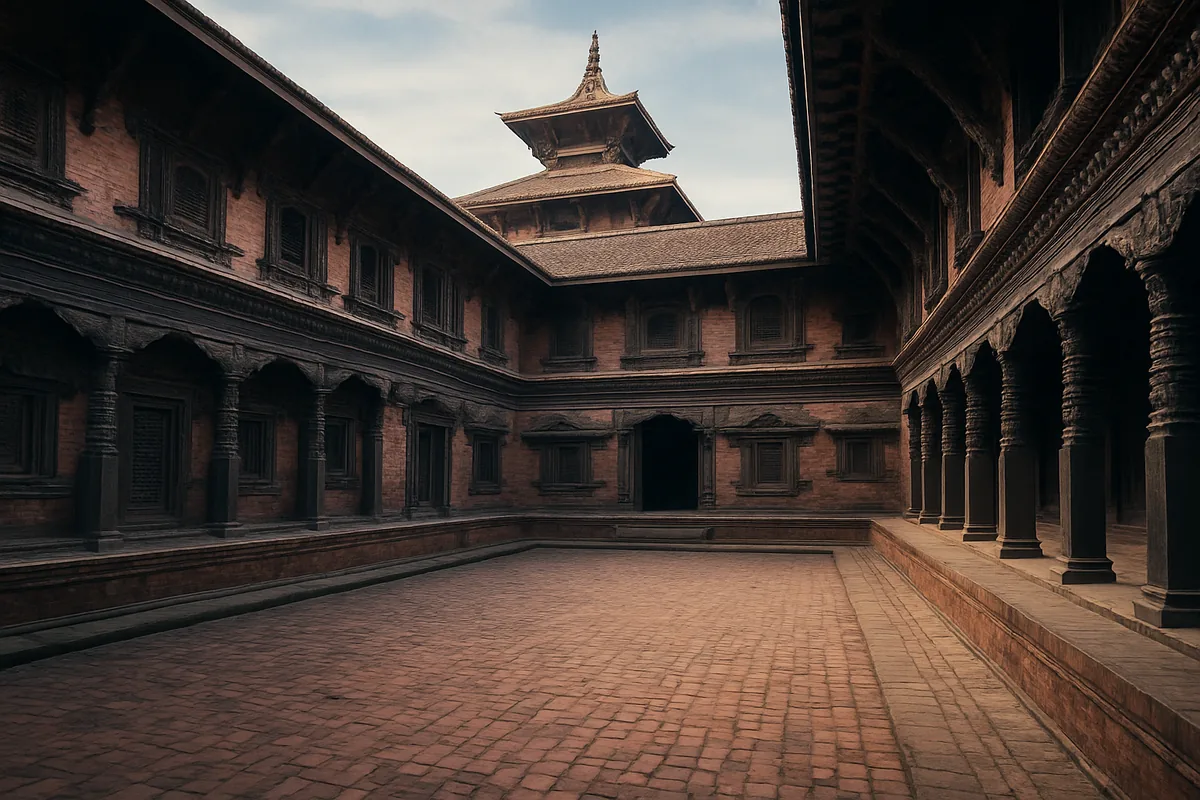
The square’s architectural character comes from the close arrangement of temples, palace buildings, and open public areas. Rather than reading as a single façade, the space presents several building forms at once: tiered roofs, carved timber details, brick surfaces, and stonework appear across different structures. Their placement around the square makes the surrounding public space part of the architectural experience, providing changing views as visitors move through it. Krishna Mandir is a notable example within this mix. Built in 1637 under the Malla ruler Siddhi Narsingh Malla, it is a stone temple whose form contrasts with the tiered-roof temples nearby. The palace complex adds another scale, with building fronts and internal courtyards marking transitions between the open square and more enclosed spaces. These elements show how religious, royal, and civic functions were accommodated within one urban center. Courtyards contribute to the layout by creating interior spaces behind the more public edges of the square. Together, the buildings and open areas form a sequence of thresholds rather than a uniform plaza. Details such as rooflines, doorways, and carved windows gain meaning in relation to the surrounding structures: their effect comes partly from how closely they sit together in the historic center.
A Visit Beyond One Monument
A visit here can extend from the main square into connected courtyards and the surrounding streets, where the urban setting continues beyond the best-known buildings. Moving between these spaces reveals how the historic center is organized: open public areas meet narrower routes, and prominent structures sit among buildings used for ordinary city life. This connected layout distinguishes Patan from a visit focused on entering, viewing, and leaving a single monument. Allow time to notice the transitions between spaces, not only the most recognizable temple or palace frontage. From one point, the square may read as a broad civic space; a short walk into an adjoining lane can bring the close scale of brick façades and doorways into view. Access to individual buildings and courtyards can vary, so the visit need not depend on entering every structure. The surrounding streets still help explain how the square fits into Lalitpur. For a practical plan, set aside several hours if you want to visit the square and nearby streets at an unhurried pace. Check locally which buildings are open, then keep the route flexible so the main public spaces remain the focus.
Thamel
Thamel is an urban neighborhood best approached as a stretch of city life rather than a single landmark. Its streets combine movement, storefronts, places to eat and stay, and the changing rhythms of a busy central district. For visitors weighing things to do in Kathmandu, it offers a different kind of stop from a temple or palace visit: the focus is on observing the street and finding your way through it. The experience can vary from a lively main street to a quieter side lane within a short walk. A little attention to movement and personal space makes moving through the neighborhood more comfortable.
Neighborhood Character
Thamel is a working urban neighborhood, not a monument with a single entrance or a fixed route. Its identity comes from a close-grained street network: busier roads connect to narrower lanes, and the view changes quickly between junctions, shopfronts, and building entrances. Walking through gives a sense of how a compact part of Kathmandu accommodates both daily movement and visitors.
The streetscape is mixed in scale and use. Ground-floor businesses sit beside lodging, eateries, and other services, while signs, balconies, overhead wiring, and closely spaced facades create a layered visual field. Rather than looking for one central feature, notice how each block changes: a broad stretch can feel exposed and fast-moving, while a side lane may be quieter and easier to take in at walking pace.
That variety makes Thamel useful for unhurried urban observation. A short walk can reveal changes in street width, sound, foot traffic, and the balance between local routines and visitor-oriented activity. These details are the neighborhood’s main point of interest, not a substitute for the architectural focus of Kathmandu’s historic sites.
Allow time to follow a simple loop or revisit a junction from another direction. This approach keeps the visit grounded in the neighborhood’s street pattern and helps you notice details that are easy to miss while moving quickly.
Street Life and Cultural Contrast
Thamel’s street life is encountered in motion: pedestrians share the road with vehicles, people pause at entrances, and deliveries or errands can alter the flow from one moment to the next. The experience is open-ended, with no single focal point directing attention. Visitors can observe how a busy commercial district works without treating every interaction as a performance or attraction.
A visit centered on religious practice has a different emphasis: attention belongs to the sacred setting and the conduct of those gathered there. A historic-architecture visit, by contrast, draws the eye toward designed spaces, carved surfaces, and the arrangement of buildings. In Thamel, the subject is the everyday urban scene—how people pass, meet, wait, and negotiate limited street space.
This contrast is useful when planning Kathmandu sightseeing. Thamel suits a flexible walk with time to notice changing street activity; religious and historic destinations call for attention to their particular setting and purpose. The neighborhood should not be read as a summary of all Kathmandu life, since its visitor-facing streets represent one urban setting among many.
For a more attentive visit, choose a walking pace that leaves room to stop without blocking others. Looking from a junction or a building edge can reveal the pattern of movement while keeping the focus on the street as a shared public space.
Street Photography Considerations
Busy streets reward a light, considerate approach. Keep the camera ready without stopping in the middle of a narrow passage, and adjust your position as people and vehicles change the available space.
- Watch pedestrian flow before framing a shot; narrow lanes can fill quickly, so step to a clear edge rather than blocking doorways or the path of people carrying goods.
- Ask permission before making an identifiable portrait, especially when a person is the main subject; a brief, clear request is more respectful than photographing first.
- Keep cameras away from private interiors, residential thresholds, and people engaged in personal conversations unless they have explicitly agreed to be photographed.
- Expect changing conditions as traffic, deliveries, weather, and the density of pedestrians shift; pause, reassess the scene, and avoid rushing across moving traffic for a frame.
- Use a compact setup when possible, and check that a strap, tripod, or bag does not obstruct a tight sidewalk or create a hazard at a crowded junction.
When in doubt, lower the camera and give people room to pass. The most practical approach is to photograph from a safe edge, seek consent for portraits, and leave private spaces unrecorded.
Choosing Places for Your Interests
Kathmandu sightseeing can combine sacred places, historic civic spaces, and busy commercial streets, but each offers a different kind of visit. The five settings below range from Buddhist and Hindu landmarks to an active urban neighborhood. Comparing their architecture, surroundings, and visual character can help you choose places that fit your interests and available time. For the best results, consider what you want to experience rather than treating one destination as essential for everyone.
Compare the Five Settings
These five Kathmandu historic sites and urban settings differ in religious context, built form, and the activity around them. Four are components of the Kathmandu Valley UNESCO World Heritage property, inscribed in 1979; Thamel is a neighborhood rather than a monument.
| Place | Cultural setting | Architecture | Neighborhood atmosphere | Photography potential |
|---|---|---|---|---|
| Boudhanath Stupa | Tibetan Buddhist pilgrimage and community life | Large, white hemispherical stupa with a square tower | A devotional center surrounded by shops, monasteries, and cafes | Wide views of the stupa, prayer flags, and circumambulating visitors |
| Pashupatinath Temple | Major Hindu sacred complex beside the Bagmati River | Pagoda-style temple buildings, shrines, and riverside structures | A broad religious precinct with activity along the riverbanks | Architectural details and river scenes, subject to access and photography rules |
| Swayambhunath | Buddhist complex with Hindu shrines and practices | Central stupa, smaller shrines, and structures across a hillside | A hilltop religious setting above the surrounding city | Stupa details, hillside views, and city panoramas when visibility allows |
| Patan Durbar Square | Historic civic square in Lalitpur, within the Kathmandu Valley | Palaces, courtyards, temples, and carved wood and brickwork | A public historic center woven into the surrounding city streets | Temple façades, courtyards, carved details, and changing street activity |
| Thamel | Contemporary commercial and visitor district | Mixed shopfronts, signs, hotels, and older street buildings | Dense, active streets with businesses and pedestrian movement | Street scenes, shop displays, signs, and contrasts in daily urban life |
The visual opportunities depend on where photography is permitted and on conditions such as crowd levels and light. Religious sites invite attention to their living uses as well as their architecture, while Thamel offers a distinctly commercial street setting.
Match a Place to Your Priorities
If you want a Buddhist setting shaped by pilgrimage and community life, consider Boudhanath; if Hindu worship and a riverside religious complex are central to your interests, Pashupatinath is the more relevant choice. Swayambhunath may suit visitors interested in a hilltop complex where Buddhist and Hindu traditions share the setting. These distinctions are more useful than assuming that any one spiritual landmark represents every aspect of Kathmandu culture. For historic architecture, Patan Durbar Square brings palaces, temples, courtyards, and public streets into one urban environment. Those interested in Kathmandu cultural attractions beyond monumental buildings may prefer Thamel’s active commercial character, or combine it with a historic site to see a contrast in the city’s built environment. Patan is in Lalitpur, so allow for travel between it and central Kathmandu when arranging a visit. Photographers can choose according to subject: architectural detail at Patan, a broad stupa composition at Boudhanath, a hillside panorama at Swayambhunath, or street activity in Thamel. At Pashupatinath, prioritize the religious setting and permitted viewpoints over close images of people or ceremonies. If you have limited time, select one or two places that match your main interest rather than trying to cover every setting in a single outing.
Plan Around Changing Conditions
Opening arrangements, access to particular areas, photography permissions, and visitor conditions can change with religious events, maintenance, or site management. A route or viewpoint available on one date may not be available on another, and rules can differ between an outdoor courtyard and an active shrine. Check current notices at each site and follow posted instructions or guidance from staff and local religious representatives. Religious context should shape both the choice of destination and the way you move through it. Give worshippers space, avoid interrupting ceremonies, and do not assume that a camera is welcome simply because other visitors are taking pictures. Where photography is restricted, keep the camera away; where it is allowed, choose subjects and distance with care. For a practical visit, match one or two destinations to your interests, then confirm current access and photography rules before setting out.