
How to Approach These Photo Spots
Kathmandu’s photographic settings range from active religious precincts to historic squares and tightly woven commercial streets. These five suggestions offer contrasting subjects rather than a ranked list of the best places to photograph in Kathmandu. The scene in front of you matters as much as the landmark: repeated forms, building lines, open views and human activity call for different framing choices. Conditions and access can vary, so treat each location as a starting point for observing and composing.
A Range of Religious and Neighborhood Scenes
The five settings span Buddhist and Hindu religious places, historic architecture and everyday neighborhood streets. Boudhanath and Swayambhunath offer Buddhist architectural forms; Pashupatinath is a Hindu religious complex beside the Bagmati River. Kathmandu Durbar Square brings historic buildings into a civic setting, while Thamel’s lanes present a commercial neighborhood at street level. Together, they make Kathmandu photography spots varied in scale and subject, not interchangeable backdrops.
Scene character should guide your photographic choices. Repeated architectural details can support a frame built around rhythm and pattern, while a wider view can establish how a landmark sits within its surroundings. At a historic square, vertical lines and roof levels may become the main structure of an image. In neighborhood streets, layered signs, doorways and passing figures can create depth, but a crowded frame may also obscure the relationships between those elements.
Before choosing a lens or position, decide whether the photograph is about a single form, the surrounding space or the way people use that space. A moderate focal length can balance a building detail with its setting; a wider lens includes more context but makes edge placement and converging lines more noticeable. For street scenes, keep the frame attentive to both its visual layers and the people within it. This approach makes the differences between religious, architectural and neighborhood subjects a practical part of composition.
Comparing Scene Types and Sensitivity
Use the comparison to match a compositional approach to the setting; focal lengths are flexible starting points, not requirements.
| Setting | Scene type | Composition possibilities | Sensitivity |
|---|---|---|---|
| Boudhanath | Buddhist religious precinct | Repeated forms and close architectural details; a 35–70 mm range can isolate patterns or retain some context. | High: keep the sacred setting central to framing decisions. |
| Pashupatinath | Hindu religious complex by the Bagmati River | Architectural relationships and broader environmental views; 24–35 mm can include more setting, while 50–85 mm narrows attention. | Very high: the religious and riverside context calls for especially careful judgment. |
| Swayambhunath | Hilltop religious architecture with city context | Wide framing can connect structures and surroundings; 24–35 mm suits broader views, while 50 mm can emphasize a smaller grouping. | High: balance architectural description with the significance of the place. |
| Kathmandu Durbar Square | Historic architecture in a public square | Use 24–35 mm for facades and spatial relationships, or around 50 mm for architectural details. | Moderate to high: consider the setting as both historic architecture and an active public place. |
| Thamel | Commercial neighborhood streets | A 35–50 mm view can hold street layers without making the frame excessively broad. | Context-dependent: street photography involves people as well as buildings and signs. |
Choose detail-led framing for repeated forms, wide views for setting, architectural framing for building structure and street-life framing for neighborhood layers. Start with the scene’s dominant character, then refine your position and lens choice.
Boudhanath Stupa
Boudhanath is a Buddhist stupa in Kathmandu, with a large central form that rewards both close study and carefully layered frames. Its architectural symmetry offers a strong starting point for photography, while the surrounding activity gives images a sense of scale and place. For Boudhanath Stupa photography, consider how each viewpoint relates the structure to its setting rather than treating it as an isolated object. Light, distance, and the movement of people can all change the balance of a composition. Follow current site rules, and make respect for worship part of every photographic decision.
Architectural Form and Repeated Detail
The stupa’s broad white dome, square harmika, and painted eyes create distinct shapes that can anchor a frame. For architectural photography in Kathmandu, use these features as connected forms, then let repeated details guide the viewer through the image.
- Place the dome low or centrally in the frame, using its curved outline as a visual base beneath the more compact harmika and upper structure.
- Keep the painted eyes level when making a frontal composition; a small shift to one side can reveal depth without losing the face-like symmetry.
- Use prayer flags as directional lines, positioning their strands across a corner or edge so they lead toward the stupa rather than obscure its profile.
- Look for repeated architectural forms across the structure, then frame a section tightly to turn pattern and rhythm into the main subject.
- Include a clear foreground edge, such as part of the surrounding walkway, to separate the stupa’s rounded mass from the buildings behind it.
- Try a wider view for the full silhouette and a tighter frame for painted surfaces or repeated details; check the edges for distracting overlaps.
A level camera keeps the stupa’s stacked geometry legible, while a slight off-center viewpoint adds depth. Choose the framing that best connects its large forms with finer details.
Activity Around the Stupa
People moving around Boudhanath can show the scale of the dome and give an architectural frame a human context. A wider view from a respectful distance may include walkers in the foreground, the stupa beyond them, and surrounding buildings as a third layer. Keep the architectural outline readable: wait for a gap in the movement or place figures near the edge rather than letting a cluster cover the structure. A longer focal length can compress those layers, while a wider lens makes the space between foreground and stupa more apparent. The activity is part of a place of worship, not simply background material. Avoid treating anyone as a prop, and ask before making a close portrait; photographing from farther away does not automatically establish permission. Be attentive to worshippers’ movement and avoid interrupting their path to secure a frame. Posted instructions and access conditions can change, so check current site rules before photographing and follow any limits on where cameras may be used. When the scene feels crowded, a patient, wider composition is often more effective than moving closer. In practice, distance and a clear background layer provide context while keeping worship undisturbed.
Pashupatinath ghats
Pashupatinath is a Hindu temple complex beside the Bagmati River, where steps, shrines, and riverbanks form a closely connected setting. The ghats make the relationship between built space and water central to any photograph, while worship and daily activity call for particular care. Access and photography rules may differ across areas of the complex, so confirm what is permitted on arrival. A considered approach can record the riverside architecture without treating people or religious observances as scenery.
Bagmati Riverside Setting
Pashupatinath is a Hindu temple complex by the Bagmati River, with temple grounds, riverside steps, shrines, and the water occupying connected but distinct parts of the scene. From an authorized public viewpoint, the river can serve as a foreground line leading toward the built forms; a slight diagonal often gives the steps and bank more depth than a straight-on frame.
For architectural photography in Kathmandu, look for relationships between rooflines, stone or brick surfaces, and the river rather than isolating a single façade by default. A moderate wide-angle lens, around 24–35 mm on a full-frame camera, can hold a shrine and its river context without the strong edge stretching of an ultra-wide lens. Keep verticals upright when the building is the subject, or let converging lines remain deliberate when emphasizing the slope to the water.
The river’s changing level and the arrangement of steps affect how much water appears in the frame, so check the view before choosing a composition. A tighter frame can emphasize repeated architectural details, while a wider one shows how the temple grounds meet the bank. Choose a position that is clearly permitted and leaves worshippers’ paths unobstructed.
Privacy, Worship, and Photography
The ghats are an active religious riverside setting, not simply an architectural backdrop. Before raising a camera, consider these practical boundaries:
Swayambhunath hill
Swayambhunath’s hilltop setting brings religious architecture and Kathmandu’s urban landscape into close visual conversation. The same location can support tightly framed details as well as compositions that include the city. Changes in viewpoint and framing help determine how much of each appears in the photograph. Consider the scale of the subject before choosing a composition.
Hilltop Architecture and City Context
Swayambhunath is a Buddhist religious complex on a hill in Kathmandu, with a central stupa and a cluster of shrines, chaityas, and other religious structures. The elevation makes the site useful for photographs that place an architectural subject against the valley’s urban fabric, rather than isolating each monument from its surroundings.
The stupa provides a strong vertical anchor: its white dome supports a square tower painted with Buddha eyes, above which a gilded spire rises in diminishing tiers. From different points around the hilltop, shifts in distance bring the dome, subsidiary shrines, and rooftops into changing relationships. A small change of position can separate overlapping rooflines or align them deliberately behind the tower.
This architectural layering shows how a religious complex occupies Kathmandu’s elevated edge. A tighter view can record brickwork, painted surfaces, metal fittings, or prayer wheels, while a broader frame can include terraces and the dense buildings below. Rooftops and ridgelines make useful supporting context, though haze or other conditions may limit their visibility. Among the best places to photograph in Kathmandu, Swayambhunath stands out for this close-to-wide transition.
When composing, check the edges of the frame for cropped shrines, poles, or rooflines that compete with the stupa. A level horizon and deliberate spacing between the tower and nearby structures keep the architecture legible while preserving the hilltop relationship with the city.
Framing Details and Wider Views
Choose a framing scale according to the relationship you want to show: surface detail, the arrangement of structures, or the hilltop within Kathmandu. Moving your viewpoint can change those relationships without requiring a different subject.
- Close detail: Fill the frame with the stupa’s painted eyes, gilded metalwork, brick patterns, or a prayer wheel to emphasize texture and crafted form.
- Medium frame: Include the stupa with a nearby shrine or roofline, using their different shapes to show how structures sit together on the hill.
- Layered city view: Place a shrine or stupa in the foreground and rooftops beyond it, keeping the architectural subject distinct from the urban background.
- Wide context: Include more of the hilltop and surrounding city where visible, allowing the complex’s elevated position to read as part of the composition.
Wide compositions depend on what the conditions and available viewpoint reveal; a city backdrop may be partial rather than panoramic. For a balanced set of photographs, pair one clear architectural detail with a medium frame that shows its setting.
Durbar Square at dawn
Kathmandu Valley has several historic durbar squares, including Kathmandu Durbar Square and Patan Durbar Square. These civic and religious settings bring palace architecture, temples, courtyards, and street activity into a compact photographic scene. Dawn describes a transition in ambient light, not a promise of empty streets, access, or a particular look. Strong images can pair a legible architectural form with a closer detail that shows how buildings and public space meet.
Architecture and Street-Level Details
Kathmandu Durbar Square offers broad architectural compositions built from tiered temple roofs, palace façades, courtyards, and the lines of surrounding buildings. A wider frame can establish how these forms relate across the square: place a roofline against the open sky, or use paving and a courtyard edge to lead toward a façade. Keep verticals controlled by holding the camera level; tilting upward can make tall structures appear to lean, while a wider lens may exaggerate that effect.
Closer views shift attention from the whole ensemble to its materials and construction. Carved timber struts beneath eaves, lattice windows, brick courses, door surrounds, and metal fittings offer distinct textures and repeated patterns. A detail becomes more informative when the frame retains a spatial clue, such as the edge of a doorway beside its carved panel or a window set within a brick wall. This relationship gives the surface scale and context rather than isolating ornament as an abstract pattern.
For photography in Kathmandu Durbar Square, alternate between a building-scale frame and one precise street-level detail. Compare how a person-sized doorway, a stretch of paving, or the gap between two façades changes the perceived scale of the architecture. This approach records both the square’s formal structure and the details encountered at walking height.
Dawn as Changing Ambient Light
Dawn is a useful way to describe the interval when the sky brightens before and around sunrise; its appearance changes with cloud, season, and the direction of open sky around the square. Before direct sunlight reaches a surface, skylight can render brick and timber in cooler tones with softer edge contrast. If direct sun begins to strike a façade, highlights and shadowed recesses may separate more strongly, and warm color can appear on lit surfaces while nearby areas remain cool.
Exposure choices should follow the actual scene rather than a preset idea of sunrise. An ISO 100–400 starting range and an aperture around f/5.6–8 can preserve detail when ambient light permits, but a slower shutter or higher ISO may be needed as brightness falls. Check the histogram and highlight detail on pale walls or bright sky; a single meter reading can underexpose dark wood or clip the brightest areas. Changing clouds can also alter contrast within minutes.
Conditions at dawn vary, so compose for the light present rather than assuming a particular atmosphere. A practical approach is to make one balanced architectural frame, then adjust exposure for either the façade’s texture or the brighter sky.
Thamel alleys
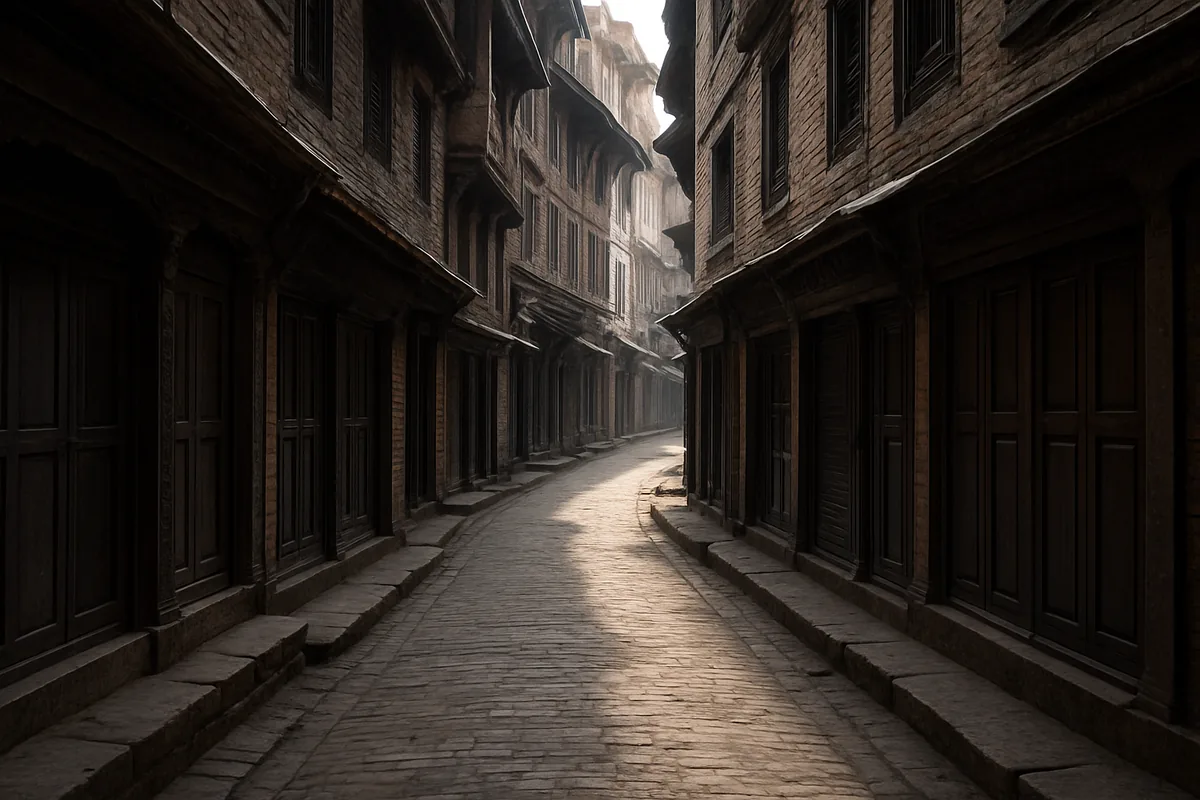
Thamel offers a compact setting for Kathmandu street photography, with lanes where close foregrounds and receding façades can share a frame. The visual structure changes from one junction to the next: a view may open briefly, then narrow between building edges. Signs, doorways, balconies, and overhead lines create distinct planes without requiring a wide panorama. Light also shifts across these confined spaces as direct sun reaches some surfaces while others remain shaded. Build a composition around the geometry and exposure available at each viewpoint rather than expecting uniform conditions.
Layered Streetscapes
In Thamel’s dense lanes, a photograph can hold several street planes at once: a nearby doorway or passing figure in the foreground, façades at mid-distance, and a narrowing strip of street beyond. These layers make even a short sightline feel deep. Look for a junction or opening where the eye can travel past an edge instead of meeting a flat wall immediately.
Building edges provide useful framing. A vertical wall at one side can anchor the image, while a balcony, awning, or sign creates a horizontal layer above the street. Keep these lines deliberate: a small change in camera position can separate a roofline from an overhead wire or prevent a doorway from merging with a figure. A 28–35 mm equivalent view can include context while retaining a clear foreground subject.
Foreground activity gives scale and direction, but it need not fill the frame. Let a person, bicycle, or handcart occupy one part of the composition while successive façades remain legible behind it. If the nearest layer becomes visually dominant, step aside or wait for a clearer interval; if the lane feels flat, include a close edge to lead into the distance. This approach makes the best places to photograph in Kathmandu feel specific to their street geometry.
Light Across Dense Alleys
Narrow streets can place bright façades beside deeply shaded doorways, creating a wider brightness range than the camera can record cleanly in one exposure. Check the histogram or highlight warning after a test frame: pale walls may lose texture before a shaded foreground becomes readable. When detail in the bright area matters most, expose for it and allow the darkest recesses to remain dark; when foreground detail matters, shift exposure carefully and watch for clipped highlights.
Changing light can also alter the color and separation of street planes. Direct sun may pick out one wall while nearby surfaces stay cool and subdued, whereas open shade can soften contrast across a foreground subject. Try a tighter frame that excludes a bright patch, or use a wall edge to divide sunlit and shaded areas. A small adjustment in viewpoint can change the balance without relying on a particular time or weather.
For adaptable golden hour photography in Kathmandu, treat each alley as a sequence of changing light rather than a guaranteed effect. Compare the exposure on a bright surface with the detail in the nearest shade, then choose which should carry the image. A deliberate frame with one clear tonal priority usually works best.
Choosing a Scene and Photographing Respectfully
The best Kathmandu photography spots depend on whether you want monumental forms, lived-in streets, or a quieter architectural study. Each of these five settings offers a different balance of religious significance, daily activity, and room to compose a wider view or isolate a detail. Access, available light, and permission to photograph can vary by location and moment, so treat a planned frame as an option rather than a certainty. Compare the settings first, then let posted rules and the people present shape your final choice.
Comparing the Five Settings
These locations suit different visual priorities; the table compares their broad character without assuming that every viewpoint or activity will be available on a particular visit.
| Setting | Architecture | Religious context | Street life | Composition range |
|---|---|---|---|---|
| Boudhanath | A prominent stupa provides a strong, rounded architectural subject. | A Buddhist sacred setting; activity and access may vary. | Movement around the landmark can add human scale. | Try an overall silhouette or close studies of repeated forms. |
| Pashupatinath | Temple architecture sits within a riverside complex. | An active Hindu worship site with significant privacy considerations. | Public movement shares space with religious and family activity. | Architectural details may be more appropriate than people-focused frames. |
| Swayambhunath | A hilltop complex combines religious structures with elevated surroundings. | A sacred setting where visitors and worshippers may share routes. | People, structures, and the city can enter the same scene. | Choose between close architectural studies and broad city context. |
| Durbar Square | Historic palace and temple forms create varied architectural lines. | Religious and civic heritage meet in a public square. | Street-level movement can give scale to façades and courtyards. | Frame a larger streetscape or concentrate on carved details. |
| Thamel | Dense lanes offer an intimate, built-up streetscape. | Religious features may appear alongside everyday commercial spaces. | Shopfronts, pedestrians, and changing activity shape street scenes. | Layered alley views favor tighter compositions and near-to-far depth. |
For architectural photography in Kathmandu, compare the scale of the subject with the space around it before choosing a lens or viewpoint. The best places to photograph in Kathmandu are the ones whose activity and access suit the frame you can make respectfully that day.
Consent and Site Rules
Conditions differ between public streets, sacred precincts, and individual structures. Use these practical checks before making a frame.
- Read signs at entrances and within each site; if photography is restricted in an area, put the camera away rather than relying on rules from another location.
- Ask permission before making an identifiable portrait, especially when someone is engaged in worship, working, or accompanying a child.
- Follow directions from site staff and locally communicated guidance; if the permitted areas are unclear, ask before setting up or changing position.
- Keep a respectful distance from worship and private moments, and avoid blocking pathways, entrances, ceremonies, or other visitors’ access while composing.
- Choose a wider frame that excludes identifiable people, or wait for a clear view, when consent is unavailable or a close portrait would intrude.
A camera’s presence does not establish permission, and a familiar viewpoint may still be unavailable. A practical approach is to choose the setting that fits your subject, verify current rules on arrival, and make the least intrusive frame that tells the story.